C'est officiel, Microsoft vient de lancer le programme Office 2016 Preview officiellement.
Plus d'informations ici: http://blogs.office.com/2015/03/16/announcing-the-office-2016-it-pro-and-developer-preview/
C'est officiel, Microsoft vient de lancer le programme Office 2016 Preview officiellement.
Plus d'informations ici: http://blogs.office.com/2015/03/16/announcing-the-office-2016-it-pro-and-developer-preview/
Dans le cadre de la préparation du lab du CCIE Collaboration, il est primordial d'être capable de monter Intercluster Trunk (ICT) SIP entre deux clusters.
2.0 Configure and Troubleshoot Cisco Unified Communications Manager (CUCM) |
40% |
Hide Details |
|
2.1 CUCM SCCP endpoints 2.2 CUCM MGCP gateways 2.3 CUCM SIP endpoints and trunks 2.4 CUCM H.323 gateways and trunks |
||
Lien contenu lab: https://learningnetwork.cisco.com/docs/DOC-20804
Pour créer la jonction, il est nécessaire d'effectuer la configuration sur les deux clustes (site principal et secondaire).
Étapes de configuration:
1 - Site principal - Création Region:
Création d'une région spécifique pour le trunk pour gagner en flexibilité dans la configuration (gestion des codecs) si besoin.
2 - Site principal - Création Device Pool:
Création d'un Device Pool spécifique au Trunk pour gagner en flexibilité dans la configuration.si besoin;
Précisez:
- Nom du DP;
- Association du groupe CUCM;
- Information de temps;
- La région;
3 - Site principal - Création Trunk:
Dans Device - Trunk, faire "Add New", préciser:
- Le Device Pool;
- Le nom du Trunk;
- Le CSS pour les appels entrants;
- Les IP des cucm du cluster du site SB et le port d'écoute (5060 par défaut, sauf si vous avez utilisé un SIP Trunk Security Profile custom);
- Redirecting Diversion Header Delivery - Inbound activé;
- Redirecting Diversion Header Delivery - Outbound activé;
- SIP Trunk Security Profile;
- SIP Profile
4 - Site principal - Création Route Group:
5 - Site principal - Création Route List:
6 - Site principal - Création Route Pattern:
7 - Site secondaire - Création Region:
8 - Site secondaire - Création Device Pool:
9 - Site secondaire - Création Trunk:
10 - Site secondaire - Création Route Group:
11 - Site secondaire - Création Route List:
6 - Site secondaire - Création Route Pattern:
Dans le cadre de la préparation du lab du CCIE Collaboration, il est primordial d'être capable de monter un Non-Gatekeeper Controlled Intercluster Trunk (ICT) entre deux clusters.
2.0 Configure and Troubleshoot Cisco Unified Communications Manager (CUCM) |
40% |
Hide Details |
|
2.1 CUCM SCCP endpoints 2.2 CUCM MGCP gateways 2.3 CUCM SIP endpoints and trunks 2.4 CUCM H.323 gateways and trunks |
||
Lien contenu lab: https://learningnetwork.cisco.com/docs/DOC-20804
Un trunk ICT (Non-Gatekeeper Controlled) utilise le protocole H.323.
Pour créer la jonction, il est nécessaire d'effectuer la configuration sur les deux clustes (site principal et secondaire).
Étapes de configuration:
1 - Site principal - Création Region:
Création d'une région spécifique pour le trunk pour gagner en flexibilité dans la configuration (gestion des codecs) si besoin.
2 - Site principal - Création Device Pool:
Création d'un Device Pool spécifique au Trunk pour gagner en flexibilité dans la configuration.si besoin;
Précisez:
- Nom du DP;
- Association du groupe CUCM;
- Information de temps;
- La région;
3 - Site principal - Création Trunk:
Dans Device - Trunk, faire "Add New", préciser:
- Le Device Pool;
- Le nom du Trunk;
- Le CSS pour les appels entrants;
- Les IP des cucm du cluster du site SB;
- Display IE Delivery activé;
- Redirecting Number IE Delivery - Outbound activé;
- Redirecting Number IE Delivery – Inbound activé;
4 - Site principal - Création Route Group:
5 - Site principal - Création Route List:
6 - Site principal - Création Route Pattern:
Étape nécessaire pour envoi le plan de numérotation du site SB (2XXX) dans la route liste.
7 - Site secondaire - Création Regionl:
6 - Site secondaire - Création Device Pool:
7 - Site secondaire - Création Trunk:
6 - Site secondaire - Création Route Group:
6 - Site secondaire - Création Route List:
6 - Site secondaire - Création Route Pattern:
Microsoft vient de publier une mise à jour du client Lync 2013 pour Mac
Version:14.0.11
KB3037358
Date: 13 mars 2015
Description:
|
Product |
Version |
KB |
Download |
|
Lync for Mac |
14.0.11 |
J'ai un peu de retard sur l'information, mais depuis fin Janvier, le bundle NFR Collaboration 10.6 est disponible.
La nouveauté dans ce bundle est que maintenant, cela inclut pour un an le Cisco Software Support Services (SWSS).
Description:
The Cisco® Collaboration Partner Demo, Lab, Training Bundle 10.6 is made available to Cisco partners for internal demonstration and testing purposes. This offering provides partners easy access to Cisco Collaboration System Release (CSR) software products in a single bundle. The licensing in the bundle is designed to cover 20 users.
The Partner Bundle Offer includes 1 year of Cisco Software Support Services (SWSS) which gives access to major upgrades and minor updates, maintenance, and access to online resources, including Technical Assistance Center (TAC) from a single contract see http://www.cisco.com/web/partners/services/sell-and-market/software-support-service.html
The following partners can order the Collaboration 10.6 Partner Bundle:
Partners’ specializations and status are checked for eligibility before the Bundle is shipped. When ordering please allow up to one week for this partner verification. Orders are processed with 24 to 48 hours after partner verification and are available for download within three days of verification. An email confirmation is sent when the eDelivery is ready
Bundle Content
For full details of the bundle content and the included license quantities please refer to the Collaboration Partner Demo, Lab, Training Bundle 10.6 Description Collaboration Partner DLT Bundle 10.6 Description and the Collaboration Partner DLT Bundle 10.6 Q and A
See the Collaboration Partner Demo, Lab, Training Bundle 10.6 thread on the Cisco community https://communities.cisco.com/thread/49007
The software is not intended for and should not be used for production systems and is not for resale. Software or software licenses provided in this bundle may not be transferred or reused for production systems Neither can they be resold, re-distributed or installed or extended to any customer site in any way. No hosted or managed service may be offered to customers using the Partner Bundle software. By purchasing this Bundle partners agree to a Supplement to the Cisco End User License Agreement reflecting these restrictions. Supplement to the Cisco End User License Agreement for the Cisco Collaboration DLT Bundle Software This bundle is delivered via electronic delivery only. For more information on electronic delivery, see the Cisco eDelivery page at http://www.cisco.com/web/partners/tools/edelivery.html.
Lien: https://cisco.mediuscorp.com/market/networkers/productView.se.work?/nxt/rcrs/proieidentity/=20252
Microsoft vient de publier une mise à jour pour le client Lync 2013.
KB: KB2956174
Lien: http://support2.microsoft.com/kb/2956174/en-us
Résolutions:
Problèmes connus:
After you install this update, you may experience the issues that are described in the following Microsoft Knowledge Base articles:
Vous préparez le CCIE Collaboration?
Vous souhaitez collaborer avec d'autres personnes le préparant aussi?
Rejoignez notre study group!
A 75% francophone pour l'instant, on est 3 francais et demi + 1 anglophone travaillant au TAC a collaborer pour la préparation de cette certification.
Ce groupe a pour objectif de tout partager sans restriction:
Au plaisir, envoyez moi un MP pour discuter de votre intégration dans le processus
L'objet de cet article est de configuré l'intégration sur le site SB entre le cucm et le routeur voix en sip.
Étapes de configurations:
1 - Vérification du matériel:
SB#show inventory
NAME: "2811 chassis", DESCR: "2811 chassis"
PID: CISCO2811 , VID: V04 , SN: FTX1124A3YE
NAME: "2nd generation two port FXO voice interface daughtercard on Slot 0 SubSlo
t 0", DESCR: "2nd generation two port FXO voice interface daughtercard"
PID: VIC2-2FXO , VID: V01 , SN: FOC10480ER8
NAME: "One port T1 voice interface daughtercard on Slot 0 SubSlot 1", DESCR: "On
e port T1 voice interface daughtercard"
PID: VWIC-1MFT-T1= , VID: 1.0, SN: 35227201
NAME: "4 Port FE Switch on Slot 0 SubSlot 2", DESCR: "4 Port FE Switch"
PID: HWIC-4ESW , VID: V01 , SN: FOC15240T7P
NAME: "WIC/VIC/HWIC 2 Power Daughter Card", DESCR: "4-Port HWIC-ESW Power Daught
er Card"
PID: ILPM-4 , VID: V02 , SN: FOC15233SFV
NAME: "WAN Interface Card - Serial (1T) on Slot 0 SubSlot 3", DESCR: "WAN Interf
ace Card - Serial (1T)"
PID: WIC-1T= , VID: 1.1, SN: 9937053
NAME: "PVDMII DSP SIMM with four DSPs on Slot 0 SubSlot 4", DESCR: "PVDMII DSP S
IMM with four DSPs"
PID: PVDM2-64 , VID: V01 , SN: FOC10221QK0
2- Activation du port T1
card type t1 0 1
3- Configuration horloge
SB(config)#network-clock-participate wic 1
SB#show network-clocks
Network Clock Configuration
---------------------------
Priority Clock Source Clock State Clock Type
10 Backplane GOOD PLL
Current Primary Clock Source
---------------------------
Priority Clock Source Clock State Clock Type
10 Backplane GOOD PLL
SB(config)#network-clock-select 1 t1 0/1/0
SB#show controllers t1 0/2/0
T1 0/1/0 is up.
Applique type is Channelized T1
Cablelength is long gain36 0db
No alarms detected.
alarm-trigger is not set
Soaking time: 3, Clearance time: 10
AIS State:Clear LOS State:Clear LOF State:Clear
Version info Firmware: 20090113, FPGA: 20, spm_count = 0
Framing is ESF, Line Code is B8ZS, Clock Source is Line.
CRC Threshold is 320. Reported from firmware is 320.
Data in current interval (295 seconds elapsed):
0 Line Code Violations, 0 Path Code Violations
8 Slip Secs, 0 Fr Loss Secs, 0 Line Err Secs, 0 Degraded Mins
8 Errored Secs, 0 Bursty Err Secs, 0 Severely Err Secs, 0 Unavail Secs
Data in Interval 1:
0 Line Code Violations, 0 Path Code Violations
6 Slip Secs, 0 Fr Loss Secs, 0 Line Err Secs, 0 Degraded Mins
6 Errored Secs, 0 Bursty Err Secs, 0 Severely Err Secs, 0 Unavail Secs
Data in Interval 2:
3 Line Code Violations, 4 Path Code Violations
0 Slip Secs, 0 Fr Loss Secs, 2 Line Err Secs, 1 Degraded Mins
2 Errored Secs, 0 Bursty Err Secs, 0 Severely Err Secs, 0 Unavail Secs
Total Data (last 2 15 minute intervals):
SB#show network-clocks
Network Clock Configuration
---------------------------
Priority Clock Source Clock State Clock Type
1 T1 0/1/0 GOOD T1
10 Backplane GOOD PLL
Current Primary Clock Source
---------------------------
Priority Clock Source Clock State Clock Type
1 T1 0/1/0 GOOD T1
4- Définir le global switch type:
SB(config)#isdn switch-type primary-ni
5- Configuration du controleur T1: les commandes vont automatiquement générer l'interface série et le port voix pour être utilisé pour la signalisation ISDN D-Channel.
SB(config)#controller t1 0/1/0
SB(config-controller)#pri-group timeslots 1-3
SB#show run interface serial 0/1/0:23
Building configuration...
Current configuration : 138 bytes
!
interface Serial0/1/0:23
no ip address
encapsulation hdlc
isdn switch-type primary-ni
isdn incoming-voice voice
no cdp enable
end
SB#show run | sec voice-port
voice-port 0/0/0
voice-port 0/0/1
voice-port 0/1/0:23
SB#show isdn status
Global ISDN Switchtype = primary-ni
ISDN Serial0/1/0:23 interface
dsl 0, interface ISDN Switchtype = primary-ni
Layer 1 Status:
ACTIVE
Layer 2 Status:
TEI = 0, Ces = 1, SAPI = 0, State = MULTIPLE_FRAME_ESTABLISHED
Layer 3 Status:
0 Active Layer 3 Call(s)
Active dsl 0 CCBs = 0
The Free Channel Mask: 0x80000007
Number of L2 Discards = 0, L2 Session ID = 1
Total Allocated ISDN CCBs = 0
6- Configuration SIP globale sur le routeur:
SB(config)#voice service voip
SB(conf-voi-serv)#no ip address trusted authenticate //désactivation juste pour les besoins du lab
SB(conf-voi-serv)#allow-connections h323 to sip
SB(conf-voi-serv)#allow-connections h323 to h323
SB(conf-voi-serv)#allow-connections sip to sip
SB(conf-voi-serv)#allow-connections h323 to h323
SB(conf-serv-sip)#bind control source-interface fastEthernet 0/1
SB(conf-serv-sip)#bind media source-interface fastEthernet 0/1
7- Configuration des dial-peer sur le routeur:
SB(config)#voice class codec 1 //création d'une classe pour la négociation des codecs
SB(config-class)#codec preference 1 g711ulaw
SB(config-class)#codec preference 2 g729r8
SB(config)#dial-peer voice 1 pots //dial-peer POTS
SB(config-dial-peer)#incoming called-number . //match n'importe quel DNIS
SB(config-dial-peer)#direct-inward-dial //empeche un comportement type "two-stage dialing"
SB(config)#dial-peer voice 10 voip
SB(config-dial-peer)#destination-pattern 3123332...$
SB(config-dial-peer)#session protocol sipv2
SB(config-dial-peer)#session target ipv4:10.10.23.11
SB(config-dial-peer)#voice-class codec 1
SB(config-dial-peer)#dtmf-relay rtp-nte sip-notify
SB(config-dial-peer)#no vad
8- Configuration Cisco Call Manager:
Device- Trunk:
MGCP (RFC 2705) est un protocole client/serveur qui permet au call manager de connaitre et contrôler un port spécifique de la passerelle. Cela permet donc aussi la centralisation de l'administration des passerelles et de toute la gestion du dial plan.
Les commandes sont tranportées au UDP 2427 entre l'environnement call manager et les passerelles.
L'implémentation de MGCP vient avec un concept de PRI Backhaul permettant au call manager de controler le signalisation data Q.931 utilisé sur le port PRI de la passerelle.
Étapes de configurations:
1 - Vérification du matériel:
HQ#show inventory
NAME: "chassis", DESCR: "2801 chassis"
PID: CISCO2801 , VID: V01 , SN: FCZ093311XV
NAME: "motherboard", DESCR: "C2801 Motherboard with 2 Fast Ethernet"
PID: CISCO2801 , VID: V01 , SN: FOC092624PU
NAME: "WIC/VIC/HWIC 1", DESCR: "WAN Interface Card - Serial (1T)"
PID: WIC-1T= , VID: 1.0, SN: 13852239
NAME: "WIC/VIC 2", DESCR: "One port T1 voice interface daughtercard"
PID: VWIC-1MFT-T1= , VID: 1.0, SN: 32255346
NAME: "WIC/VIC/HWIC 3", DESCR: "WAN Interface Card - Serial (1T)"
PID: WIC-1T= , VID: 1.0, SN: 19220982
NAME: "PVDM 0", DESCR: "PVDMII DSP SIMM with three DSPs"
PID: PVDM2-48 , VID: V01 , SN: FOC101317R0
NAME: "PVDM 1", DESCR: "PVDMII DSP SIMM with one DSP with half channel capcity"
PID: PVDM2-8 , VID: NA , SN: FOC0946011N
2- Activation du port T1
card type t1 0 2
3- Configuration horloge
HQ(config)#network-clock-participate wic 2
HQ#show network-clocks
Network Clock Configuration
---------------------------
Priority Clock Source Clock State Clock Type
11 Backplane GOOD PLL
Current Primary Clock Source
---------------------------
Priority Clock Source Clock State Clock Type
11 Backplane GOOD PLL
HQ(config)#network-clock-select 1 t1 0/2/0
HQ#show controllers t1 0/2/0
T1 0/2/0 is up.
Applique type is Channelized T1
Cablelength is long gain36 0db
No alarms detected.
alarm-trigger is not set
Soaking time: 3, Clearance time: 10
AIS State:Clear LOS State:Clear LOF State:Clear
Version info Firmware: 20090113, FPGA: 20, spm_count = 0
Framing is ESF, Line Code is B8ZS, Clock Source is Line.
CRC Threshold is 320. Reported from firmware is 320.
Data in current interval (3 seconds elapsed):
0 Line Code Violations, 0 Path Code Violations
0 Slip Secs, 0 Fr Loss Secs, 0 Line Err Secs, 0 Degraded Mins
0 Errored Secs, 0 Bursty Err Secs, 0 Severely Err Secs, 0 Unavail Secs
HQ#show network-clocks
Network Clock Configuration
---------------------------
Priority Clock Source Clock State Clock Type
1 T1 0/2/0 GOOD T1
11 Backplane GOOD PLL
Current Primary Clock Source
---------------------------
Priority Clock Source Clock State Clock Type
1 T1 0/2/0 GOOD T1
4- Définir le global switch type:
HQ(config)#isdn switch-type primary-ni
5- Configuration du controleur T1, les commandes vont automatiquement générer l'interface série et le port voix pour être utilisé pour la signalisation ISDN D-Channel.
HQ(config)#controller t1 0/2/0
HQ(config-controller)#pri-group timeslots 1-3 service mgcp
HQ#show run interface serial 0/2/0:23
Building configuration...
Current configuration : 138 bytes
!
interface Serial0/2/0:23
no ip address
encapsulation hdlc
isdn switch-type primary-ni
isdn incoming-voice voice
no cdp enable
end
HQ#show run | sec voice-port
voice-port 0/2/0:23
6- Configuration Backhaul:
La configuration va permettre que la signalisation Q.931 normalement recu par le routeur soit transféré directement au CUCM.
HQ(config)#interface serial 0/2/0:23
HQ(config-if)#isdn bind-l3 ccm-manager
7- Configuration MGCP sur le routeur:
HQ(config)#mgcp call-agent 10.10.13.12 //HQ CUCM subcriber
HQ(config)#ccm-manager mgcp //Activation "Call Manager Application" pour mgcp
HQ(config)#mgcp // activation mgcp sur le routeur
HQ#show ccm-manager
MGCP Domain Name: HQ.nissarte.ca
Priority Status Host
============================================================
Primary Registering with CM 10.10.13.12
First Backup None
Second Backup None
Current active Call Manager: None
Backhaul/Redundant link port: 2428
Failover Interval: 30 seconds
Keepalive Interval: 15 seconds
HQ#show isdn status
Global ISDN Switchtype = primary-ni
%Q.931 is backhauled to CCM MANAGER 0x0003 on DSL 0. Layer 3 output may not appl
y
ISDN Serial0/2/0:23 interface
dsl 0, interface ISDN Switchtype = primary-ni
L2 Protocol = Q.921 0x0000 L3 Protocol(s) = CCM MANAGER 0x0003
Layer 1 Status:
ACTIVE
Layer 2 Status:
TEI = 0, Ces = 1, SAPI = 0, State = TEI_ASSIGNED
Layer 3 Status:
0 Active Layer 3 Call(s)
Active dsl 0 CCBs = 0
The Free Channel Mask: 0x80000007
Number of L2 Discards = 0, L2 Session ID = 1
Total Allocated ISDN CCBs = 0
La partie Layer 2 du PRI étant géré directement par le CUCM, le routeur n'étant pas encore déclaré dans la configuration, le statut actuel est TEI_ASSIGNED puisque aucune frames Layer 2 n'est échangé avec mon routeur PSTN.
8- Configuration Cisco Call Manager:
Device- Gateway:
Vérification du nom du routeur:
HQ#SHOW CCM-manager
MGCP Domain Name: HQ.nissarte.ca
9- Redondance: Ajout du CUCM Publisher en tant que backup:
HQ(config)#ccm-manager redundant-host 10.10.13.11
Vérification:
HQ#show ccm-manager
MGCP Domain Name: HQ.nissarte.ca
Priority Status Host
============================================================
Primary Registered 10.10.13.12
First Backup Backup Ready 10.10.13.11
Second Backup None
Current active Call Manager: 10.10.13.12
Backhaul/Redundant link port: 2428
Failover Interval: 30 seconds
HQ#show isdn status
Global ISDN Switchtype = primary-ni
%Q.931 is backhauled to CCM MANAGER 0x0003 on DSL 0. Layer 3 output may not appl
y
ISDN Serial0/2/0:23 interface
dsl 0, interface ISDN Switchtype = primary-ni
L2 Protocol = Q.921 0x0000 L3 Protocol(s) = CCM MANAGER 0x0003
Layer 1 Status:
ACTIVE
Layer 2 Status:
TEI = 0, Ces = 1, SAPI = 0, State = MULTIPLE_FRAME_ESTABLISHED
Layer 3 Status:
0 Active Layer 3 Call(s)
Active dsl 0 CCBs = 0
The Free Channel Mask: 0x80000007
Number of L2 Discards = 0, L2 Session ID = 1
Total Allocated ISDN CCBs = 0
Matt Landis vient de publier sur les galleries Technet un outil tres sympa: Call Monitor Pro for Skype for Business & Lync
Description:
Call Monitor Pro for Lync and Skype for Business brings "Call Monitor" feature, Enhanced Functionality and Extensibility to Skype for Business and Lync 2013 users at no cost.
Enterprise features (paid)
Get Enterprise Edition
http://attendantpro.blogspot.com/2015/03/call-monitor-pro-enterprise-inquiry.html
FAQ
Q. Why doesn't the setup or components of setup download?
A. Make sure your firewall is not blocking it, especially Sonicwall Antivirus application blocking.
Q. How does Call Monitor Pro compare to Skype for Business "Call Monitor" feature?
A. Some high level areas where Call Monitor Pro goes beyond Skype4B "Call Monitor" includes:
Pour le télécharger: https://gallery.technet.microsoft.com/office/Call-Monitor-Pro-Community-e30e71b8
La version Office 2016 pour Mac est disponible en preview.
Vous pouvez la télécharger ici: http://products.office.com/fr-CA/mac/mac-preview
Un descriptif directement sur le blog Office: http://blogs.office.com/2015/03/05/office-2016-mac-preview/
Petit "irritant" du jour.
Installation d'un nouveau Edge dans le cadre d'un nouveau projet Lync Server 2013 (petit, 2000 utilisateurs).
Probleme:
L'étape 1 du wizard d'installation génère systématiquement l'erreur suivante:
En powershell, même comportement.
Toutes les tentatives de résolutions du probleme sur internet ont échouées.
Résolution:
Repartir sur une nouvelle machine virtuelle toute neuve...
Bien qu'ayant déployé ou participé au déploiement de plus de 70 projets Microsoft UC depuis 2008, l'étape de la préparation de la forêt reste toujours un moment sans réel sérénité dans la démarche.
Nouveau projet ce matin, nouvelle erreur:
Error: Container CN=Microsoft,CN=Program Data,DC=*******,DC=com not found
► Details
3/4/2015 10:56:48 AM Error
└ Error: An error occurred: "Microsoft.Incubation.Crypto.GroupKeys.ObjectNotFoundException" "Container CN=Microsoft,CN=Program Data,DC=****,DC=com not found"
Vérification dans Adsiedit, le conteneur "Program Data" est absent.
La résolution fut donc la (re)création de ce conteneur:
Vous pouvez maintenant relancer la préparation de la fôret.
Il existe un petit outil sympa permettant de synchroniser la présence de votre client Lync avec votre compte Skype.
L'application se nomme LinkLyncPresence,
Vous pouvez avoir accès au détail et a la procédure d'installation/configuration de l'outil directeur sur le site du créateur:
Il est maintenant possible de disposer de machines virtuelle Kemp gratuitement pour des labs:
KEMP's Free LoadMaster has the same core functionality as the commercial version of the product and is available at a limited performance, at zero cost
Comparaison edition free et commerciale:
Plus d'informations et téléchargement ici: http://freeloadbalancer.com/
Vous avez une expérience Lync, Office 365?
Un bagage en téléphonie?
Vous souhaitez immigrer au Québec ou en Ontario?
Contactez moi en MP!
Leader dans la téléphonie Microsoft au Quebec, avec l'ouverture du bureau de Toronto, le developpement d'opportunité dans le reste du Canada, et l'afflux de nouveaux projets, on recherche activement une personne bilingue pouvant intégrer mon équipe UC constitué déja de 5 personnes.
Vous voulez apprendre Lync?
Je dispense les MOC suivant au centre AFI Expertise de Montréal et Québec:
Le programme et les dates sont disponibles sur les liens.
Au plaisir.
Intéressante information mise à jour le 25 février sur le technet: https://technet.microsoft.com/en-us/library/dn913785.aspx
La date officielle n'est pas toujours pas connue, mais le descriptif est intéressant:
Changes are coming to Lync Online in Office 365. Lync is joining the Skype family, so in the coming months, Lync will be changing to Skype for Business. Please check back because this page will be updated frequently to provide you with important information about the Skype for Business client and the Skype for Business Online service. We hope that by giving you this information, it will help you through this transition.
Release date - The release date of Skype for Business will be announced at a later time.
Benefits - After your organization is transitioned to Skype for Business, you and your users will benefit from:
Skype-inspired design With the same look and feel of the Skype client, your users will benefit from the same familiar user interface and ease of use with the new Skype for Business clients.
Global reach Voice and video connectivity to the entire Skype network.
Full Lync feature set Because Skype for Business builds on existing Lync features, no features or functionality will be lost.
What to expect - Everything Lync is becoming Skype for Business. . . . . . . .
Lync 2013 clients is changing to Skype for Business clients.
Lync Web app is changing to Skype for Business web app.
Lync admin center is changing to Skype for Business admin center.
Lync Online is changing to Skype for Business Online.
How is the Lync client experience changing?
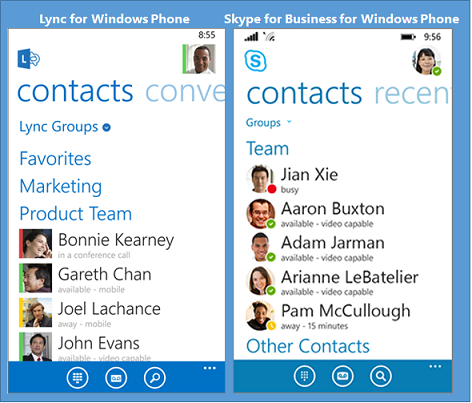
Contact window and features are inspired by Skype

Meetings experience and controls with the look and feel of Skype

Skype for Business taskbar icon

Skype for Business title bars
The Lync mode Skype for Business client

The Skype for Business client

Windows Search will return both Lync and Skype for Business

The Skype design vs. the Lync mode design – In a future update posted to this page, you will be able to change from the new Skype client design to the familiar Lync client design for your users. These settings will allow you to toggle between the two designs that your users will use for Skype for Business. Part of the update to this page, we will provide detailed instructions on how you can change from the new Skype design to the Lync mode Skype design.
Vous pouvez télécharger les présentations des techdays 2015.
Pour Lync/Skype:
Pour Office365:
Microsoft vient de publier une mise a jour pour Lync Serveur 2013.
Version: 5.0.8308.871
Publication: Février 2015
KB:
Correctifs:
Vous pouvez télécharger l'ensemble de ces mises a jours ici: http://www.microsoft.com/en-us/download/details.aspx?id=36820
Procédure d'installation de ces mises a jours ici: http://microsofttouch.fr/default/b/christophe/archive/2014/11/17/microsoft-lync-server-2013-installer-une-cumulative-update
Vous pouvez télécharger la presentation "Ensuring Media Quality in the Network" ici:
Skype4B: Ensuring Media Quality in the Network: summit.office.com/Media/Default/Office%20365%20Summits/ITP32%20-%20Ensuring%20Media%20Quality%20in%20the%20Network_v04-1.pptx
Skype for Business est une nouvelle version très attendue. Pour l'instant, cette release est annoncée pour une disponibilité quelque part dans le premier semestre 2015, aucune date fixe est connue a ce jour.
Skype for Business est le successeur de Microsoft Lync Serveur 2013.
Officiellement, lors du premier summit Office365 de cet année, Microsoft a commencé a lever le voile concernant les nouvelles fonctionnalités, les améliorations et l'architecture.
Quoi de neuf pour la partie architecture et design?
Vous pouvez télécharger la présentation du summit ici:
Skype4B: Reference Architectures and Design: summit.office.com/Media/Default/Office%20365%20Summits/ITP28%20-%20Skype%20for%20Business%20-%20Architecture%20and%20Design%20Considerations-1.pptx
Skype for Business est une nouvelle version très attendue. Pour l'instant, cette release est annoncée pour une disponibilité quelque part dans le premier semestre 2015, aucune date fixe est connue a ce jour.
Skype for Business est le successeur de Microsoft Lync Serveur 2013.
Officiellement, lors du premier summit Office365 de cet année, Microsoft a commencé a lever le voile concernant les nouvelles fonctionnalités, les améliorations et l'architecture.
Quoi de neuf pour les nouvelles fonctionnalités pour la partie serveur et voice?
Vous pouvez télécharger la présentation du summit ici:
Skype4B: Server core and voice improvements: summit.office.com/Media/Default/Office%20365%20Summits/ITP31%20-%20Server_Core_and_Voice_Improvements_v04.pptx
Skype for Business est une nouvelle version très attendue. Pour l'instant, cette release est annoncée pour une disponibilité quelque part dans le premier semestre 2015, aucune date fixe est connue a ce jour.
Skype for Business est le successeur de Microsoft Lync Serveur 2013.
Officiellement, lors du premier summit Office365 de cet année, Microsoft a commencé a lever le voile concernant les nouvelles fonctionnalités, les améliorations et l'architecture.
Quoi de neuf pour les nouvelles fonctionnalités pour la partie service et mise à jour?
Vous pouvez télécharger la présentation du summit ici:
Skype4B: Upgrading To Skype4B: http://summit.office.com/Media/Default/Office%20365%20Summits/ITP29%20-%20Servicing%20the%20Existing%20Deployment%20&%20Upgrading%20to%20Skype%20for%20Business%20Server_v04.pptx